
The UK education system has long been regarded as a global benchmark of academic excellence. For centuries, traditional classrooms—defined by rows of wooden desks, heavy printed textbooks, rigid timetables, and high-stakes terminal examinations—were the undisputed standard. However, the modern student body is changing at an unprecedented pace.
Today’s UK learners, from GCSE and A-Level secondary students to those pursuing higher education at top-tier universities, are true digital natives. They live in a hyper-connected world driven by artificial intelligence, flexible remote schedules, and rapidly shifting career landscapes. As a result, the traditional “one-size-fits-all” pedagogical model is no longer sufficient to prepare them for the future.
To prevent becoming obsolete, the British schooling infrastructure is undergoing a massive paradigm shift. From the aggressive integration of cutting-edge EdTech to the comprehensive restructuring of national qualifications, here is a deep dive into how the future of education in the UK is shifting, how the system is changing to meet the needs of modern learners, and what these modern UK education trends mean for students navigating the academic landscape.
1. The Digital Renaissance: EdTech, Hybrid Classrooms, and Blended Learning
If the global disruptions of recent years taught the UK education sector anything, it was that learning cannot—and should not—be confined to a physical brick-and-mortar room. What started as an emergency pivot to remote learning has matured into a permanent, highly sophisticated blended learning model that defines the modern educational experience.
The Hybrid Classroom and Virtual Infrastructure
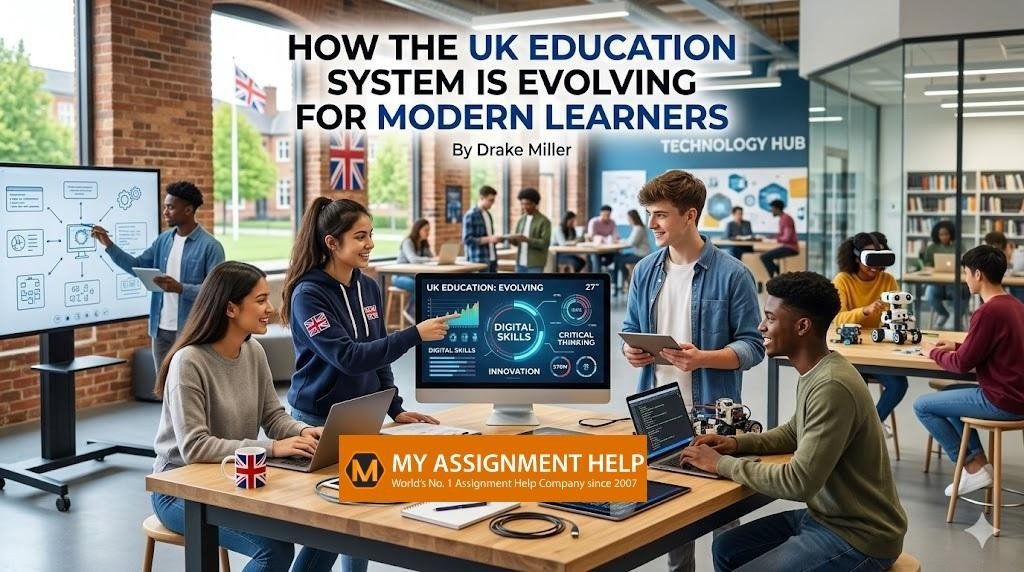
High schools, sixth forms, and universities across England, Scotland, Wales, and Northern Ireland now rely heavily on robust Learning Management Systems (LMS) such as Google Classroom, Microsoft Teams, and Canvas. The days of taking frantic, handwritten notes during a live lecture are fast disappearing. Instead, modern students expect a seamless, on-demand digital repository.
Today, learners can access high-definition recorded sessions, interactive lecture slides, and digitized reading lists at their own convenience. This flexibility is not just a luxury; it is a vital lifeline for sixth-formers balancing intense UCAS applications and university students managing part-time work to combat the rising cost of living. When these competing pressures become too overwhelming, many final-year students look for professional options like do my dissertation for me to help manage their heavy academic workloads effectively.
Gamification and Virtual Reality (VR) in the Classroom
Abstract, complex concepts are simultaneously being brought to life through immersive technology. In advanced UK secondary schools, biology students no longer just look at 2D diagrams in a book; they don VR headsets to take an interactive 3D tour through a human cell. History students are no longer just reading dates off a whiteboard; they are virtually walking through the trenches of World War I.
Furthermore, gamified learning platforms like Kahoot!, Quizlet, and Seneca Learning have transformed exam revision from a tedious, isolating chore into an engaging, competitive, and collaborative experience. By leveraging these digital toolkits, educators are successfully capturing the attention of a generation raised on interactive media.
2. Artificial Intelligence: Personalising the Student Journey and Navigating the AI Assessment Dilemma
Artificial Intelligence (AI) is no longer a futuristic concept confined to sci-fi novels; it is actively reshaping how UK students study, revise, and receive feedback. However, its integration comes with a unique set of challenges and opportunities.
Adaptive Learning Platforms for Differentiated Study
Every student learns at a completely different pace. Traditional classrooms often inadvertently leave struggling students behind while fast learners become disengaged due to a lack of stimulation. AI-powered adaptive learning platforms solve this structural flaw by analyzing a student’s performance, strengths, and weaknesses in real-time.
For instance, if an A-Level Mathematics student is struggling with complex calculus modules, the platform automatically detects the bottleneck. Instead of forcing them forward, it dynamically generates targeted practice problems and serves up specific tutorial videos to bridge that precise knowledge gap. Similarly, in highly demanding specialized fields, advanced software and specialized law dissertation help at Myassignmenthelp.com are becoming essential resources for students trying to master complex legal frameworks and rigorous research methodologies. This level of personalized, one-on-one tutoring at scale was completely unimaginable a decade ago.
Assessment Dilemma and Educational Evolution
The meteoric rise of generative AI tools like ChatGPT initially sent shockwaves through UK exam boards (such as AQA, Edexcel, OCR, and WJEC) and higher education institutions. The immediate reflex was fear over academic integrity. However, the narrative has fundamentally shifted from banning AI to integrating it ethically into the curriculum.
Students are now actively taught AI literacy—learning how to use AI as a collaborative brainstorming partner, a rapid research assistant, and a critical thinking tool, rather than a shortcut for plagiarism.
With coursework requirements changing rapidly to counter automated copy-pasting, the pressure on students to produce highly analytical, authentic, and deeply researched papers has skyrocketed. During intense exam seasons or when navigating complex university dissertations, seeking external academic guidance from Myassignmenthelp.com has become a common strategic choice. These platforms assist students looking to master complex structural frameworks, academic referencing formats (like Harvard and APA), and advanced research methodologies required by modern, AI-resistant grading rubrics.
3. Shifting Exam Landscapes: Moving Toward Continuous Assessment and Digital Exams
For generations, the UK education system has faced sharp criticism from psychologists and employment experts for its rigid “exam factory” culture. The immense pressure of achieving top marks in GCSEs and A-Levels based solely on a few high-stress hours in a silent exam hall has contributed significantly to a youth mental health crisis.
The Rise of Continuous Assessment
Recognizing both the mental health toll and the practical impracticality of testing pure rote memorization in an era where facts are instantly searchable, there is a gradual shift toward continuous, formative assessment. Secondary and tertiary educators are placing greater value on cumulative coursework, extended essays, real-world presentations, and collaborative group projects. These diverse evaluation methods mimic modern workplace environments far better than silent exam rooms ever could.
Digital Exams: Coding the Future of Testing
Major UK exam boards are actively rolling out large-scale digital exam platforms. A significant percentage of students are typing their GCSE and A-Level essays on computers rather than writing them out by hand. This evolution accommodates modern learners who are far more proficient on a keyboard than with a traditional fountain pen, ensuring that a student’s physical speed of handwriting no longer acts as an artificial bottleneck to their academic and cognitive capabilities.
4. Vocational and Technical Evolution: T-Levels vs A-Levels and the Rise of Degree Apprenticeships
For a long time, the traditional, unchallenged path to socioeconomic success in the United Kingdom was entirely linear: GCSEs $\rightarrow$ A-Levels $\rightarrow$ Three-year University Degree. Today, modern learners are sharply questioning the massive financial burden of university tuition fees against fluctuating employment outcomes, prompting a historic surge in alternative educational pathways.
What are T-Levels?
Introduced as a rigorous technical alternative to traditional A-Levels, T-Levels are two-year courses taken immediately after GCSEs. Co-designed directly with leading industry employers, one single T-Level is academically equivalent to three standard A-Levels. They perfectly blend structured classroom learning with a substantial, mandatory industry placement lasting at least 45 days. This allows high school graduates to enter the job market or higher education with tangible, practical, and highly relevant workplace experience.
The Phenomenon of Degree Apprenticeships
Degree Apprenticeships have quickly become one of the most fiercely competitive and sought-after routes for modern UK school leavers. Sponsored by major global corporations and public sector bodies (such as PwC, the BBC, Deloitte, NHS, and AstraZeneca), these programs allow high school graduates to earn a full bachelor’s or master’s degree while working full-time.
- Zero Student Debt: The corporate employer covers 100% of the university tuition fees.
- Earn While You Learn: The apprentice receives a competitive full-time salary throughout their studies.
- Guaranteed Career Trajectory: Graduates finish with years of work experience, a degree, and an established network.
It is a debt-free, employment-guaranteed evolution that is fundamentally challenging the traditional university business model.
5. Mental Health, Wellbeing, and the Implementation of Holistic Education Frameworks
The modern UK learner faces a uniquely challenging set of contemporary pressures, ranging from the localized cost-of-living crisis to intense social media scrutiny and climate anxiety. Consequently, the UK education system is expanding its scope to prioritize mental health and emotional well-being as highly as pure academic achievement.
“True academic excellence cannot exist in a vacuum. Educational institutions are realizing that an anxious, overwhelmed mind cannot retain information or innovate effectively.”
Whole-School Frameworks for Mental Wellbeing
Mental health support is no longer just an afterthought handled by an isolated, underfunded school counselor. Guided by directives from the Department for Education (DfE), schools and universities are systematically implementing comprehensive “Whole-School Approaches” to daily wellbeing. This holistic strategy includes:
- Curriculum Integration: Embedding mindfulness, stress management techniques, and emotional regulation directly into the core PSHE (Personal, Social, Health, and Economic) curriculum.
- Physical Space Adjustments: Providing dedicated quiet zones, sensory rooms, and green spaces within school boundaries to allow students to decompress.
- Digital Support Networks: Investing heavily in specialized university mental health applications, anonymous text lines, and 24/7 peer-to-peer support helplines.
By treating students as holistic individuals rather than mere statistics on an institutional league table, educational bodies are working to create environments where modern learners can truly thrive.
6. The Green Curriculum: Cultivating Sustainability and Global Citizenship
Modern UK learners are deeply passionate about social justice, ethical governance, and the unfolding climate crisis. In response to this generational shift, the UK school curriculum is actively adapting to cultivate informed global citizens who are equipped to solve the planet’s pressing ecological issues.
The Introduction of the Natural History GCSE
In a landmark, highly publicized move, the UK government announced the formal introduction of a dedicated GCSE in Natural History. This specialized course allows students to connect deeply with the local and global environmental landscape, rigorously studying biodiversity, conservation strategies, field research methodologies, and environmental sustainability.
Cross-Curricular Sustainability Threads
Sustainability is no longer isolated to an afternoon Geography lesson. It is being intentionally woven into the fabric of multiple disciplines:
- Business Studies: Shifting focus onto corporate social responsibility (CSR) and circular economies.
- Design and Technology (DT): Prioritizing sustainable material sourcing, upcycling, and eco-friendly manufacturing processes.
- English Literature: Analyzing classic and contemporary texts through the lens of eco-criticism.
Modern learners demand that their formal education align transparently with their personal ethical values, and British academic institutions are listening.
7. Lifelong Learning Entitlement (LLE) and Academic Micro-Credentials
The dated concept that a person’s formal education definitively ends in their early twenties is officially dead. The modern UK job market shifts so rapidly due to automation, machine learning, and technological innovation that continuous lifelong upskilling has become an absolute necessity for survival.
Understanding the Lifelong Learning Entitlement (LLE)
As a core pillar of its evolutionary roadmap, the UK government is rolling out the historic Lifelong Learning Entitlement. This systemic initiative provides individuals with a flexible loan entitlement equivalent to four years of post-18 education, which can be utilized dynamically over the course of their entire working lifetime.
The Power of Modular Micro-Credentials
Instead of committing blindly to a rigid, time-consuming three-year degree, modern adult learners can leverage this funding to study targeted micro-credentials. These are short, highly focused, accredited modules in high-demand fields such as cyber security, data analytics, green engineering, or digital marketing. This agile, modular approach allows workers to adapt their skill sets fluidly as their careers progress, creating a resilient, future-proof workforce.
Frequently Asked Questions
Q.1 What are the main differences between T-Levels and traditional A-Levels?
Traditional A-Levels are largely academic, classroom-focused courses evaluated via terminal examinations, preparing students for generalized higher education. T-Levels are technical equivalents designed directly with employers. They combine 80% classroom instruction with a mandatory 20% industry placement (at least 45 days) to build direct workplace competency.
Q.2 When will GCSE and A-Level digital exams be fully implemented in the UK?
Major UK exam boards (including AQA and Edexcel) have been actively piloting digital layouts. A progressive transition is underway, and a significant percentage of students are shifting away from traditional pen-and-paper writing to typed digital formats for key components during the 2025/2026 academic cycles.
Q.3 How are UK universities handling the presence of Generative AI tools?
Rather than enforcing blanket bans, UK higher education institutions and exam boards are pivoting toward ethical integration. The focus has moved to teaching “AI literacy”—showing students how to use AI for structured research and initial brainstorming while modifying assessment criteria to reward highly analytical, unique, and deeply analyzed critical work.
Q.4 What is the Lifelong Learning Entitlement (LLE) and who can use it?
The Lifelong Learning Entitlement is a government initiative providing post-18 individuals with a flexible loan entitlement equivalent to four years of higher education. It can be spaced out or used in increments over a working lifetime to fund full degrees, individual modules, or short, targeted micro-credentials in high-demand sectors.
Conclusion: Empowering the Autonomous Learner
The sweeping evolution of the UK education system can ultimately be summarized in one definitive word: Empowerment.
The nationwide system is steadily transitioning away from an authoritative, rigid, and memory-obsessed structure toward a flexible, student-centric ecosystem. Whether it is through the seamless integration of ethical AI tools, the mainstream validation of technical pathways like Degree Apprenticeships, or an expanded institutional focus on holistic mental wellbeing, modern UK learners are finally being given the keys to steer their own unique educational journeys.
As the physical boundaries between digital and brick-and-mortar classrooms continue to blur, staying on top of continuous coursework, independent research, and continuous assessments requires an incredibly high degree of self-discipline. For students navigating this fast-paced academic landscape, utilizing trusted, high-quality support systems—whether it’s collaborative digital study groups, university-sponsored wellbeing hubs, Myassignmenthelp.com — is a smart, highly strategic way to achieve long-term academic excellence without sacrificing mental and emotional balance.
About the Author – Drake Miller
I am an experienced academic content writer at Myassignmenthelp.com, dedicated to creating informative, student-centric content for learners across different academic levels. My expertise includes assignment assistance, academic planning, effective research techniques, and study improvement strategies. By delivering clear insights and practical guidance, I strive to support students in achieving stronger academic performance, building consistent study habits and navigating educational challenges with greater confidence and efficiency throughout their academic journey.
