

Introduction
Just Eat delivery robots are becoming one of the most interesting developments in modern food delivery. As customers expect faster, cheaper, and more convenient service, companies are looking for smarter ways to handle the final part of delivery. This final step, often called last-mile delivery, is one of the most expensive and difficult parts of the logistics process.
Food delivery has changed quickly over the past decade. People now order meals from their phones, track riders in real time, and expect food to arrive hot and on time. At the same time, restaurants and delivery platforms face rising costs, traffic delays, labour shortages, and pressure to reduce emissions. Delivery robots offer a possible answer to many of these problems.
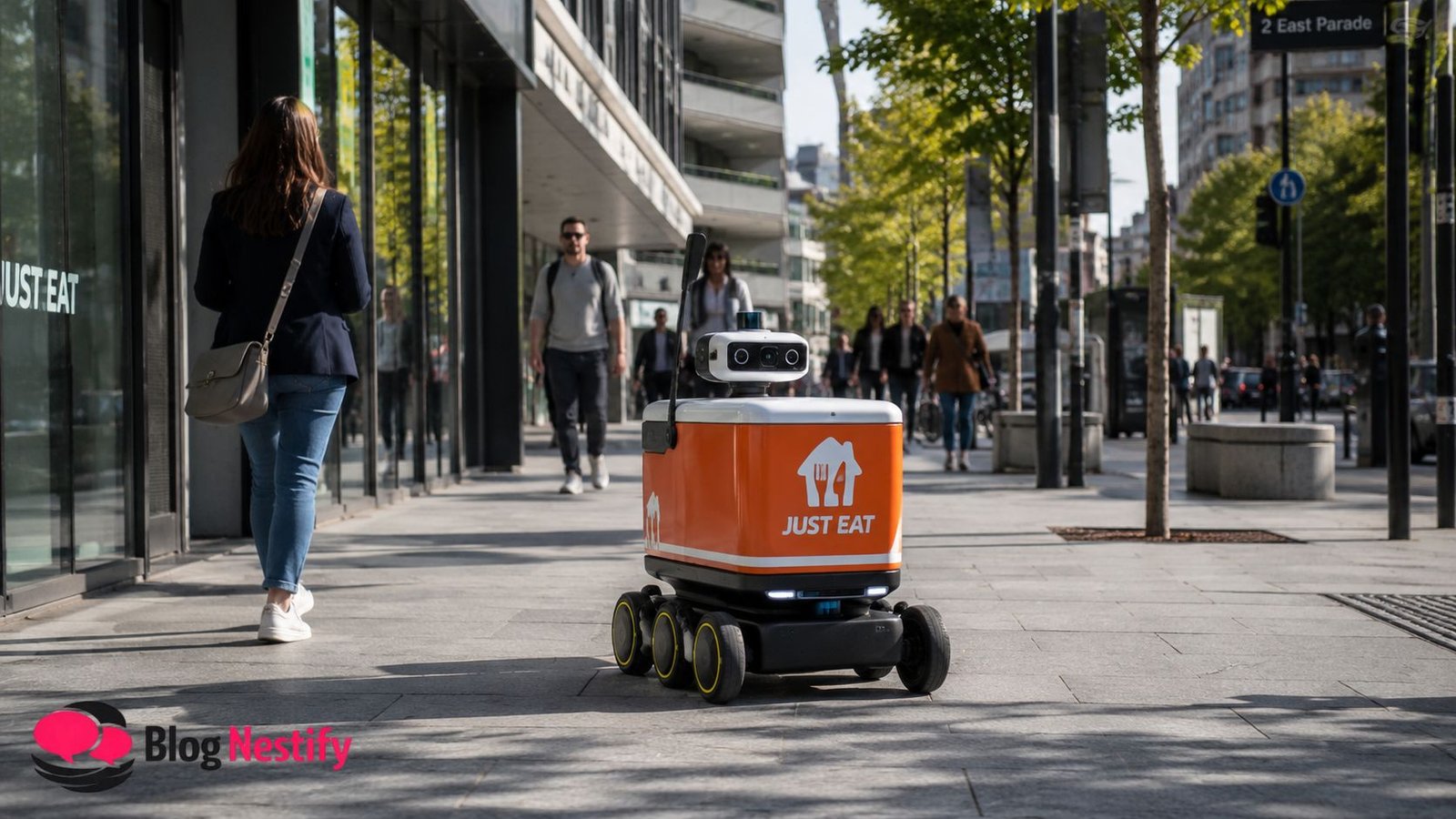
Just Eat has explored robot delivery through partnerships with autonomous delivery companies such as Starship Technologies. These small electric robots are designed to travel on pavements, carry meals securely, and deliver food directly to customers. While they may look futuristic, they are already being tested and used in selected areas.
The rise of Just Eat delivery robots is not only about technology. It is also about how cities, restaurants, customers, and delivery workers may adapt to a new type of delivery system. The future of last-mile delivery may include human couriers, electric bikes, drones, and robots working together.
| Label | Information |
|---|---|
| Topic | Just Eat Delivery Robots |
| Industry | Food Delivery |
| Technology Type | Autonomous Delivery Robots |
| Main Purpose | Last-Mile Food Delivery |
| Operated By | Just Eat Partners |
| Navigation System | GPS, Cameras, Sensors |
| Power Source | Electric Battery |
| Delivery Method | Contactless Delivery |
| Key Benefit | Faster Local Deliveries |
| Environmental Impact | Lower Carbon Emissions |
| Service Areas | Cities, Campuses, Neighborhoods |
| Customer Access | Mobile App Verification |
| Future Potential | Smart Urban Logistics |
What Are Just Eat Delivery Robots?
Just Eat delivery robots are small autonomous vehicles created to deliver food over short distances. They usually move at pedestrian speed and are designed to travel along pavements rather than roads. Their main purpose is to carry food from restaurants to nearby customers in a safe, secure, and efficient way.
These robots are not large machines or human-like robots. They are compact, box-shaped vehicles with wheels, sensors, cameras, and a locked storage compartment. Once a restaurant places an order inside the robot, the robot travels to the customer’s location. The customer can then unlock the compartment through an app or verification code.
The idea behind these robots is simple: make short-distance food delivery easier. Many food orders are placed within a small local area, especially in cities, towns, university campuses, and busy neighbourhoods. For these short journeys, a small electric robot can sometimes be more practical than a car or motorbike.
Just Eat delivery robots are part of a wider trend in autonomous delivery. Companies around the world are testing robots for groceries, parcels, and takeaway meals. The technology is still developing, but it has already shown that robot delivery can work in controlled and suitable environments.
Why Last-Mile Delivery Matters
Last-mile delivery is the final stage of the delivery journey. In food delivery, this means getting the meal from the restaurant to the customer’s door. It may sound like a small part of the process, but it is often the most complex and costly stage.
The challenge comes from several factors. Couriers must deal with traffic, parking problems, bad weather, customer availability, and route changes. In busy urban areas, a short journey can take longer than expected because roads are crowded and delivery demand is high.
For restaurants and platforms, last-mile delivery affects customer satisfaction directly. If food arrives late, cold, damaged, or at the wrong address, the customer is unlikely to be happy. This can affect reviews, repeat orders, and trust in the platform.
Just Eat delivery robots aim to improve this final step by making local delivery more predictable. A robot does not need parking, fuel, or long breaks. It can follow planned routes and operate in areas where short-distance delivery is common. However, robots are not a perfect replacement for human couriers. They are better seen as one part of a larger delivery network.
How Just Eat Delivery Robots Work
Just Eat delivery robots use a combination of sensors, cameras, GPS, mapping systems, and machine learning. These tools help the robot understand its surroundings and move safely through public spaces.
Before a robot begins delivery, the food is placed inside a secure compartment. The robot then follows a mapped route to the customer. Along the way, it can detect obstacles such as pedestrians, bicycles, kerbs, and street furniture. If needed, it can slow down, stop, or change its path.
Most delivery robots are designed with safety in mind. They move slowly and are built to operate around people. Many systems also include remote monitoring, allowing human operators to assist if the robot faces a difficult situation.
When the robot reaches the customer, the person receives a notification. The customer then unlocks the robot using the app or a secure code. This helps protect the food from theft and ensures the order is collected by the right person.
The process is designed to be simple. For customers, it can feel similar to a normal delivery, except the courier is replaced by a small autonomous robot.
Key Benefits of Just Eat Delivery Robots
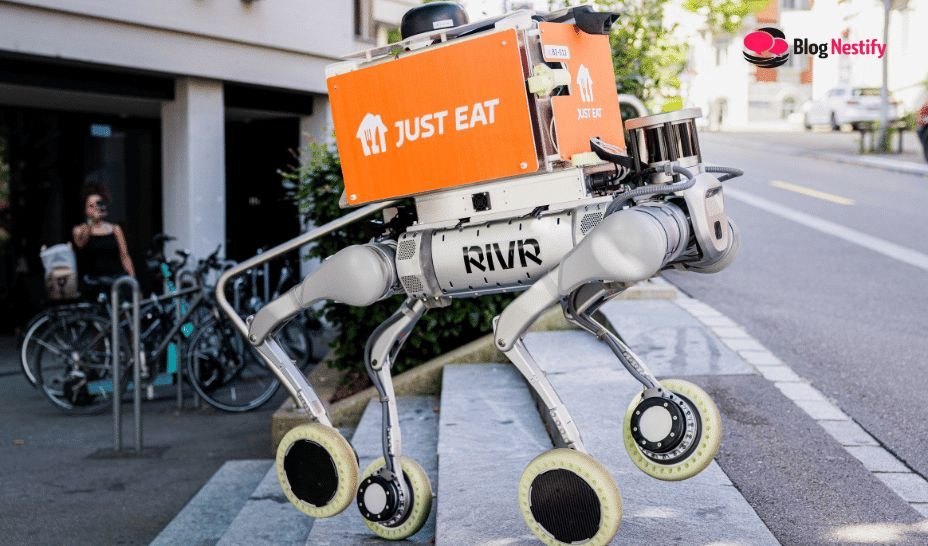
One of the biggest benefits of Just Eat delivery robots is convenience. Customers can receive their meals without direct human contact, which became especially important during and after the pandemic. Contactless delivery is still popular with many customers who prefer a quick and simple handover.
Another benefit is sustainability. Delivery robots are usually electric, meaning they can reduce the need for petrol-powered vehicles on short trips. In cities where food delivery creates extra traffic and emissions, electric robots may help lower the environmental impact.
Cost efficiency is another important factor. Human couriers are still essential, but delivery platforms are always looking for ways to reduce operating pressure. Robots may help with short, repetitive journeys, allowing human couriers to focus on longer or more complex deliveries.
Delivery robots can also improve access in certain areas. For example, university campuses, business parks, residential communities, and compact city zones can be ideal places for robot delivery. These locations often have predictable paths, regular demand, and short delivery distances.
For restaurants, robots may offer more delivery capacity during busy hours. If demand increases at lunch or dinner time, robots could help handle nearby orders without adding more vehicles to the road.
Challenges Facing Delivery Robots
Despite their promise, Just Eat delivery robots face real challenges. The first major issue is infrastructure. Pavements, crossings, kerbs, and road layouts vary from place to place. A robot that works well in one town may struggle in another area with narrow pavements or heavy foot traffic.
Weather can also affect performance. Heavy rain, snow, ice, or poor visibility may make robot delivery harder. Food delivery must be reliable, and customers expect orders to arrive even when conditions are not ideal.
Regulation is another important challenge. Cities and governments need clear rules for where delivery robots can operate, how fast they can move, who is responsible if something goes wrong, and how public safety is protected.
Public acceptance also matters. Some people may find delivery robots useful and exciting, while others may worry about pavement space, safety, job losses, or privacy. Companies need to build trust by showing that the robots are safe, respectful of public spaces, and useful to communities.
Security is another concern. Robots may face vandalism, theft attempts, or misuse. This is why locked compartments, cameras, tracking systems, and remote support are important parts of the technology.
Delivery Robots and Human Couriers
A common question is whether Just Eat delivery robots will replace human couriers. The more realistic answer is that robots may support couriers rather than fully replace them.
Human couriers are flexible. They can climb stairs, speak with customers, handle unusual addresses, react to sudden changes, and deliver over longer distances. Robots are more limited. They are best suited for short, predictable journeys in suitable areas.
In the future, food delivery may become more mixed. Robots could handle nearby orders, while human couriers manage complex deliveries, longer routes, and areas where robots cannot operate easily. This kind of blended delivery model may help platforms improve efficiency without depending on one method only.
There is also a social side to this issue. Delivery work provides income for many people. As automation grows, companies and policymakers will need to think carefully about job impact, worker rights, and new roles created by robotic delivery systems. These may include robot maintenance, remote support, fleet management, and software operations.
The Role of Artificial Intelligence
Artificial intelligence plays a central role in delivery robots. AI helps robots understand their surroundings, choose safe routes, and respond to real-world conditions. Without AI, robots would not be able to operate safely in public spaces.
Machine learning allows robots to improve over time. As robots complete more deliveries, they collect data about routes, obstacles, delivery times, and common problems. This data can help improve future performance.
AI is also useful for route planning. A delivery robot must choose a path that is safe, efficient, and suitable for its movement. It must consider crossings, pavements, pedestrians, and delivery deadlines.
In the long term, AI could help manage entire fleets of delivery robots. Instead of sending one robot at a time, platforms could coordinate many robots across a city. This could make local delivery faster, more organised, and more cost-effective.
Customer Experience
For customers, the success of Just Eat delivery robots depends on how easy and reliable the service feels. Most people do not care about the technology itself if the food arrives late or cold. The customer experience must remain simple.
A good robot delivery experience includes clear tracking, accurate arrival times, secure collection, and food that arrives in good condition. Customers also need clear instructions on how to unlock the robot and collect their order.
There is also a novelty factor. Many people enjoy seeing delivery robots for the first time. They may take photos, share videos, or talk about the experience online. This can create positive attention for Just Eat and restaurant partners.
However, novelty alone is not enough. To become a regular part of food delivery, robots must prove that they are dependable. Customers will only continue using robot delivery if it saves time, works smoothly, and feels safe.
Environmental Impact
Sustainability is one of the strongest arguments for delivery robots. Since they are electric and small, they can reduce reliance on cars and motorbikes for short journeys. This is especially important in cities where delivery traffic adds to congestion and pollution.
Food delivery platforms are under growing pressure to reduce their carbon footprint. Customers are also becoming more aware of how their choices affect the environment. Electric robots may help companies show that they are investing in cleaner delivery methods.
Still, the full environmental impact depends on several factors. Robots need electricity, maintenance, manufacturing, and operational support. Their batteries and materials also have an environmental cost. The real benefit comes when robots replace more polluting delivery methods and operate efficiently at scale.
If used wisely, Just Eat delivery robots could support greener urban delivery. They are not the only solution, but they can be part of a cleaner last-mile delivery system.
Best Places for Robot Delivery
Delivery robots are not suitable for every location. They work best in areas with short delivery distances, safe pavements, clear routes, and steady demand.
University campuses are a strong example because they often have controlled layouts and many students ordering food. Residential neighbourhoods can also work well, especially where restaurants are close to customers.
Business districts and office parks may also benefit from robot delivery. Workers often order lunch during the same time window, creating predictable demand. Robots can help manage these local delivery flows.
Dense city centres may be more difficult because of heavy pedestrian traffic, road crossings, narrow pavements, and complex layouts. Rural areas may also be less suitable because delivery distances are longer.
This means the future of Just Eat delivery robots will likely grow area by area, not everywhere at once.
The Future of Last-Mile Delivery
The future of last-mile delivery will likely be flexible, digital, and more automated. Just Eat delivery robots are part of that future, but they will work alongside other delivery methods.
In the coming years, we may see more partnerships between food delivery platforms and robotics companies. Restaurants may also become more comfortable preparing orders for robot pickup. Customers may gradually see robots as a normal part of local delivery.
Smart cities could make robot delivery easier. Better pavements, digital maps, connected traffic systems, and clear regulations could help robots operate more safely. As cities modernise, autonomous delivery may become easier to manage.
The biggest change may be in expectations. Customers already expect fast delivery. In the future, they may also expect cleaner, quieter, and more affordable delivery. Robots could help meet those expectations for short-distance orders.
Are Just Eat Delivery Robots the Future?
Just Eat delivery robots are not a complete replacement for traditional food delivery, but they are an important sign of where the industry is heading. They show how automation can solve some last-mile delivery problems, especially in local areas with high demand.
Their future depends on safety, reliability, regulation, cost, and public trust. If these challenges are managed well, robot delivery could become a normal option in many towns and cities.
For customers, the appeal is simple: food delivered conveniently, securely, and with less environmental impact. For restaurants and platforms, the appeal is better efficiency and more delivery options. For cities, the potential benefit is reduced congestion and cleaner local delivery.
The technology is still developing, but the direction is clear. Last-mile delivery is changing, and robots are becoming part of the conversation.
Conclusion
Just Eat delivery robots represent a major shift in how food delivery could work in the future. They combine automation, electric mobility, artificial intelligence, and customer convenience into one practical delivery solution.
While challenges remain, the potential is strong. Robots can help reduce delivery costs, support contactless service, lower emissions, and improve short-distance delivery in suitable areas. They also show how food delivery platforms are preparing for a future where speed, sustainability, and smart technology matter more than ever.
The future of last-mile delivery will not depend on one solution alone. Human couriers, bikes, electric vehicles, and robots may all play a role. But Just Eat delivery robots are a clear example of how the food delivery industry is moving toward a smarter and more automated future.
FAQs
What are Just Eat delivery robots?
Just Eat delivery robots are small autonomous vehicles designed to transport food orders from restaurants to customers. They use sensors, cameras, and navigation technology to travel safely along pavements.
Are Just Eat delivery robots safe to use?
Yes. These robots are built with safety features such as obstacle detection, cameras, secure compartments, and remote monitoring systems to help them operate safely in public spaces.
Can delivery robots completely replace human couriers?
Not at the moment. Delivery robots work best for short-distance deliveries, while human couriers are still needed for longer routes, complex deliveries, and areas where robots cannot easily operate.
How do customers receive food from a delivery robot?
When the robot arrives, customers receive a notification through the delivery app. They can unlock the robot’s storage compartment using a code or app verification and collect their order.
Why are Just Eat delivery robots important for the future?
They help improve delivery efficiency, reduce emissions, lower operating costs, and support the growing demand for faster and more sustainable last-mile delivery solutions.
