

As we sit midway through 2026, many investors have watched with a mix of admiration and skepticism as FAANG stocks continue to hold a commanding position in the markets. These tech giants Meta, Amazon, Apple, Netflix, and Alphabet (Google’s parent) still punch well above their weight. Even with talk of market rotations toward “real economy” sectors and occasional pullbacks, they remain central to how the broader market moves.
Their combined influence hovers around 15% of the S&P 500, a level of concentration that makes them impossible to ignore. Whether you’re a long-term investor or someone just trying to understand where capital is flowing, grasping why these companies keep leading offers valuable perspective on the forces shaping technology and finance today.
| Label | Information |
|---|---|
| Full Form | Facebook (Meta), Amazon, Apple, Netflix, Alphabet |
| Current Status | Leading tech giants dominating global markets |
| Combined Market Influence | Around 15% of the S&P 500 |
| 2026 YTD Performance | Approximately 8% group return |
| Primary Growth Driver | Heavy investments in Artificial Intelligence |
| Main Business Strength | Massive scale and strong economic moats |
| Key Revenue Sources | Advertising, cloud, hardware, e-commerce, streaming |
| Cloud Leadership | AWS and Google Cloud dominate AI workloads |
| Total AI Spending | Hundreds of billions across the group |
| Biggest Current Risk | High valuations and regulatory scrutiny |
| Financial Health | Extremely strong cash flow and balance sheets |
| Long-term Outlook | Expected to maintain leadership through 2028 |
| Best For | Long-term growth investors |
The Current State of FAANG in 2026
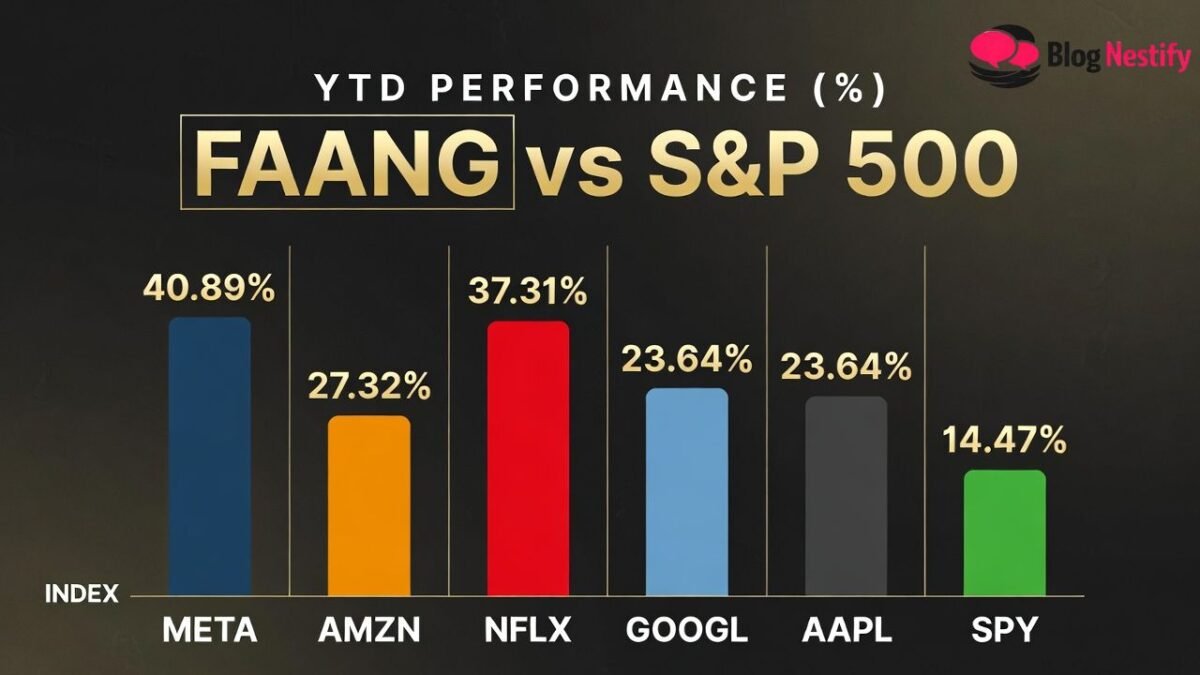
FAANG stocks have delivered solid, if not spectacular, returns so far this year. As of late May 2026, the group shows roughly 8% year-to-date gains, outperforming or staying competitive with the S&P 500 in a choppy environment. Individual performances vary: some names like Meta and Alphabet have shown resilience thanks to advertising strength and cloud momentum, while others navigate slower hardware cycles.
Market caps remain enormous. Apple hovers near $4.4 trillion, Alphabet around $4.6–4.8 trillion, and Amazon exceeds $2.7 trillion. These figures reflect not just past success but ongoing market confidence in their ability to generate cash and adapt.
What stands out is how these companies have evolved. The original FAANG label has expanded in spirit to include heavy AI and cloud focus, yet the core five continue delivering results that remind investors why they became icons in the first place. Their earnings reports this year highlighted revenue growth in the mid-to-high teens, with certain segments like cloud and digital ads pushing even higher.
Massive Investments in Artificial Intelligence
One of the clearest drivers behind FAANG’s continued leadership is their aggressive push into artificial intelligence. These companies are not just talking about AI they are pouring hundreds of billions of dollars into it.
Alphabet, Meta, Amazon, and others have raised their capital expenditure guidance for 2026, with some now planning $180–200 billion or more individually. Much of this money funds data centers, specialized chips, and AI infrastructure. The bet is that these investments will fuel the next wave of productivity gains and new revenue streams.
For example, Google Cloud has seen strong growth from enterprise AI solutions. Amazon Web Services continues benefiting from AI workloads, posting some of its best growth rates in recent quarters. Meta integrates AI across its social platforms for better ad targeting and content moderation, while Netflix refines recommendations and content creation tools. Apple focuses on on-device AI to enhance privacy and user experience in its ecosystem.
This heavy spending carries risks costs are rising fast but so far, the market rewards the vision. Companies that can turn these investments into practical, revenue-generating applications maintain their edge over smaller players who lack the scale to compete.
Cloud Computing Leadership and High-Margin Growth
Cloud infrastructure has become a cornerstone of FAANG resilience. Amazon’s AWS, Google Cloud, and even Microsoft’s influence in the space (though not pure FAANG) show how critical this segment has grown. Demand for AI-powered cloud services keeps accelerating as businesses modernize operations and adopt smarter tools.
These cloud businesses often deliver higher profit margins than traditional retail or hardware operations. They provide stable, recurring revenue that helps buffer against economic ups and downs. In 2026, cloud growth rates in the 20–60% range for certain providers have stood out, underscoring why investors remain willing to pay premium valuations.
The infrastructure these companies built years ago now positions them perfectly for the AI boom. Competitors struggle to catch up without similar global scale and engineering depth.
Diversified Revenue Streams Create Strength
Another key factor is how these businesses have spread their bets. No single segment dominates entirely, which reduces vulnerability.
- Meta relies heavily on digital advertising but expands into metaverse-related technologies and AI tools.
- Amazon mixes e-commerce with cloud services, advertising, and logistics innovation.
- Apple depends on hardware like iPhones while growing its high-margin services business (App Store, subscriptions, payments).
- Netflix focuses on streaming content but invests in live events, games, and advertising tiers.
- Alphabet balances search advertising with YouTube, cloud, and emerging areas like autonomous driving through Waymo.
This diversification helps them weather sector-specific challenges. When consumer spending slows on physical goods, cloud and ads can pick up slack. When one advertising vertical softens, others often compensate. Investors appreciate this built-in stability, especially in uncertain macroeconomic times.
Scale, Network Effects, and Economic Moats
Size itself becomes a competitive advantage. FAANG companies boast billions of users, massive troves of data, and powerful brand loyalty. These network effects make it difficult for newcomers to displace them.
Data superiority fuels better AI models and personalization. Strong balance sheets allow strategic acquisitions and research without immediate pressure. Even amid regulatory scrutiny, these firms have shown an ability to adapt adjusting policies, lobbying where needed, and innovating around constraints.
Of course, being big brings attention. Antitrust concerns and data privacy rules remain ongoing realities. Yet their financial resources and legal expertise often help them navigate these hurdles more effectively than smaller rivals.
Strong Financial Foundations
Beyond growth stories, FAANG companies generate enormous free cash flow. This allows generous share buybacks, occasional dividends, and continued heavy investment. Cash reserves provide a buffer during higher interest rate periods or economic slowdowns.
In 2026, their ability to fund massive AI capex internally without excessive debt stands in contrast to many growth companies that must rely on external financing. This financial discipline builds investor confidence and supports sustained leadership.
Acknowledging the Challenges and Risks
No honest discussion about FAANG would be complete without addressing headwinds. Valuations remain elevated for some names, raising questions about whether current prices bake in too much optimism around AI returns.
Regulatory risks are real. Governments worldwide continue examining market power, data practices, and AI safety. Potential fines, forced divestitures, or new compliance costs could impact margins over time.
Market rotation is another factor. In 2026, some capital has shifted toward industrials, energy, and other sectors perceived as undervalued or benefiting from different economic tailwinds. AI spending fatigue or disappointing returns could accelerate this shift.
Geopolitical tensions, supply chain issues, and macroeconomic uncertainty also loom. Yet these companies have survived previous cycles from dot-com bust echoes to pandemic disruptions by adapting and doubling down on innovation.
Looking Ahead: Opportunities and Evolution
The next few years could see FAANG companies deepen their AI integration across products and services. Agentic AI systems, multimodal models, robotics applications, and international market expansion offer substantial runways.
Some analysts see continued outperformance if they commercialize these technologies effectively. Others expect more normalized growth as the market broadens. Either way, their structural advantages talent pools, infrastructure, and capital access position them well for whatever comes next.
The group may evolve further, sometimes discussed alongside the broader “Magnificent 7” that includes Microsoft and Nvidia. The core principles of scale, innovation, and adaptability remain consistent.
Investment Considerations for 2026
For investors, FAANG still represents a core part of many growth-oriented portfolios. Direct stock ownership, targeted ETFs, or selective picks within the group all have merits depending on risk tolerance and time horizon.
Key questions to ask: How much exposure makes sense given current valuations? Are you betting on continued AI leadership or diversification? Dollar-cost averaging and regular rebalancing can help manage volatility.
Long-term, these companies appear likely to shape technology and markets for years ahead. Their leadership stems from deep competitive moats that competitors find hard to replicate quickly.
Why FAANG Leadership Persists
In the end, FAANG stocks continue leading because they combine massive scale with relentless innovation. Their investments in AI and cloud aren’t short-term gambles they build on years of infrastructure and data advantages. Diversified models provide resilience, while strong finances enable bold moves.
Of course, nothing is guaranteed. Markets shift, technologies evolve, and new challengers always emerge. Yet as of 2026, these companies demonstrate remarkable staying power. They adapt to challenges while capitalizing on the biggest opportunities of our era.
For anyone following business, technology, or financial markets, keeping an eye on FAANG remains essential. Their performance tells a larger story about where innovation, capital, and economic power concentrate in today’s world. Whether you invest in them directly or simply study their strategies, understanding these giants offers insights that extend far beyond any single stock ticker.
FAQs
Why are FAANG stocks still leading the market in 2026?
FAANG companies continue to lead thanks to their massive investments in AI, strong cloud businesses, and diversified revenue streams. Their scale, deep data advantages, and financial strength help them adapt faster than most competitors, even in a changing economy.
Should I invest in FAANG stocks right now?
It depends on your risk tolerance and goals. Many investors still include them for long-term growth due to their innovation edge. However, current valuations are high, so consider dollar-cost averaging and proper portfolio balance rather than going all-in at once.
What risks do FAANG stocks face in 2026?
Key risks include regulatory pressure, high valuations that could lead to corrections, and competition in AI. Economic slowdowns or disappointing returns on their heavy tech spending could also cause short-term weakness.
How is AI changing FAANG companies?
AI has become their main growth engine. From better ad targeting and cloud services to smarter recommendations and on-device features, these companies are spending billions to integrate AI across their products, creating new revenue opportunities.
Will FAANG dominance continue in the coming years?
Most signs point to continued strength if they successfully turn AI investments into real profits. Their infrastructure and resources give them a significant edge, though market rotations and new challengers could challenge their lead over time.
